How do you choose a cochlear implant system?
Read this carefully — it's very important!
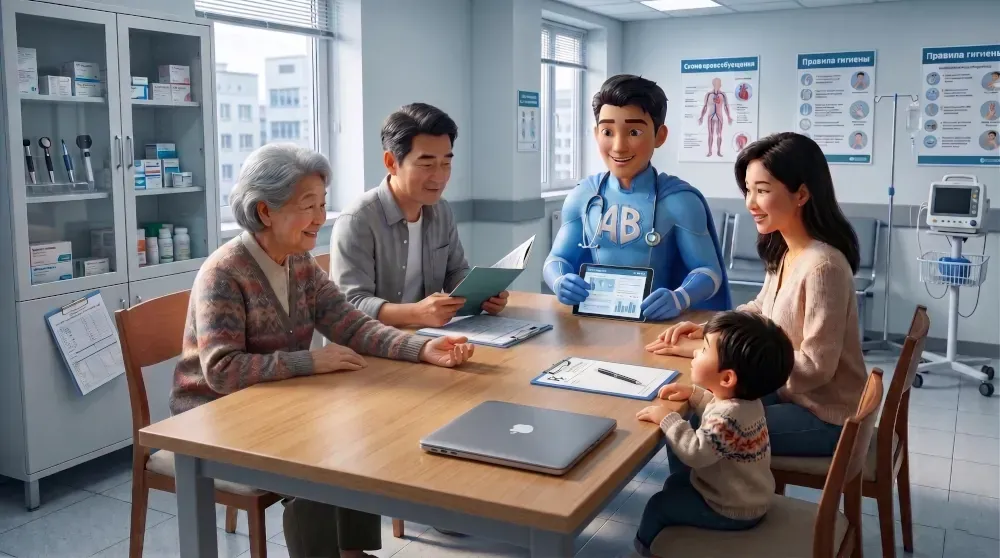
The diagnosis is set. The doctors said: cochlear implantation is needed. And now you're sitting in front of a screen, reading articles, comparing tables, trying to make sense of abbreviations — and feeling like the more you read, the less you understand.
That's normal. Choosing a cochlear implant system is one of the most important decisions in a family's life. Because this isn't buying a gadget. It's choosing a team that will be by your child's side — or yours — not for a month, not for a year, but for decades.
We won't try to convince you to "buy right now." We'll walk through what's really worth paying attention to — and explain why each of these criteria matters in real life. And at the end, you'll find a checklist of questions worth asking any specialist before making a decision.
1. Manufacturer reliability: who stands behind the system?
A cochlear implant isn't a hearing aid you can swap out after a year. It's a surgically implanted device that will stay with the patient for life. Which means the manufacturer needs to exist — and support its products — for just as long.
Advanced Bionics is part of the Sonova Group — a Swiss holding company whose shares trade on the SIX Swiss Exchange. Over 30 years, the company has helped more than 100,000 patients worldwide and is represented in more than 50 countries.
Advanced Bionics is a public company. Here's what that means for the patient:
- Strict financial reporting to regulators and shareholders — the company can't "disappear" or abruptly change course without public consequences. Any financial, medical or management problems automatically lower the company's share price. This is one reason public companies take extra care with safety and quality control of their products. If even the slightest suspicion of a product issue arises, it's instantly recalled from the market. This raises quality assurance for patients.
- International quality standards that are verified externally, not just by the company itself (ISO certificates, certificates of product origin and quality).
- A guarantee of long-term existence: in 10, 20, 30 years and beyond, the company will keep releasing updates, manufacturing compatible accessories, and providing service.
If a company isn't public, it may not adhere as strictly to quality and safety standards. So always check on this very important point.
For reference: Advanced Bionics' headquarters permanently hosts an FDA (Food and Drug Administration) staff member who monitors the quality of the products manufactured and compliance with all regulations.
This isn't a marketing promise — it's a structural guarantee.
2. Technology and innovation for life, not for the spec sheet
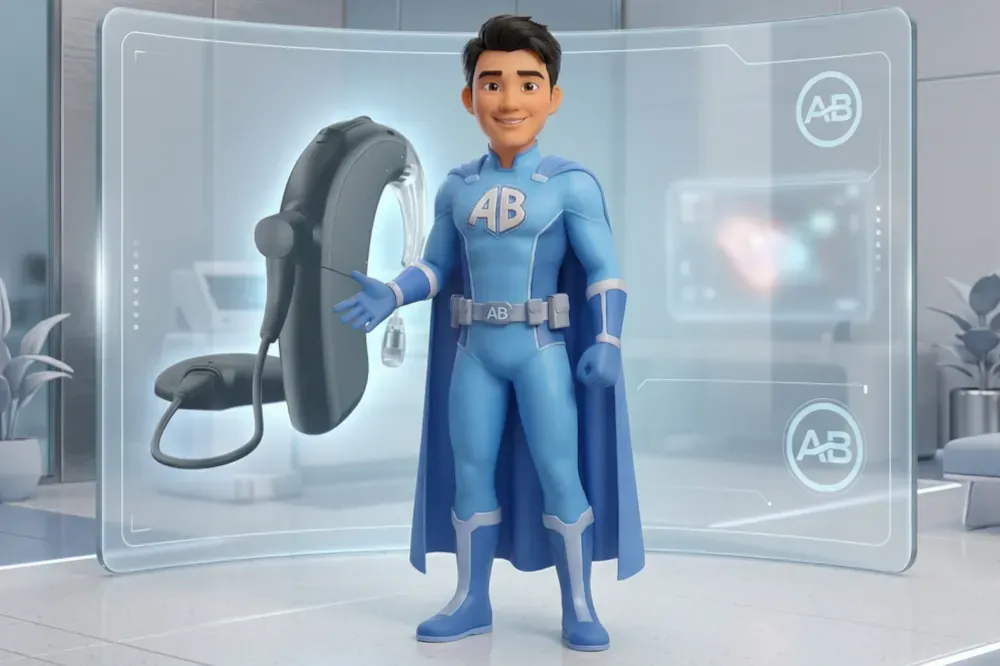
The speech processor and the implant itself are the "brains" of a cochlear implant system. The speech processor processes sound and sends the signal to the implant. The quality of this processing determines how naturally a person hears speech, music and the sounds of the world around them.
Advanced Bionics' Marvel processor is one of the most technologically advanced platforms, combining Sonova and Phonak engineering. What does that mean in real life, not on a spec sheet?
- In a noisy café or on a playground — the processor isolates the speaker's voice, suppressing background noise.
- On a phone call — sound is streamed directly via Bluetooth, without interference.
- At a music lesson or watching a cartoon — sound quality is noticeably better than in previous generations of devices.
- For patients with residual hearing in the other ear — a bimodal pairing with a Phonak hearing aid is possible, with both devices working in sync.
For a child learning to hear and speak, every nuance of sound is a building block for speech and development. Here, technology isn't a luxury — it's a rehabilitation tool.
3. Full support: from the first consultation to rehabilitation
This is where most families make a mistake when choosing: they only compare the devices themselves. But the device is only part of the story.
Cochlear implantation is a process that lasts for years. And at every stage, different specialists are needed. Our team supports the patient through all of these stages — not handing off from specialist to specialist, but guiding them through:
- Candidate selection. Not every patient is a candidate for implantation. In some situations, hearing aid fitting may work instead. It's important to determine the indications and contraindications.
- Preparing for surgery. Medical documentation, approvals and logistics require experience and coordination.
- System delivery. Getting the right equipment configuration on time is critical for meeting surgery deadlines.
- Fitting. After surgery, the speech processor is switched on for the first time, followed by regular fittings. Fitting is also available at our centers as part of OSMS (mandatory social health insurance).
- Rehabilitation. The implant provides access to sound, but learning to hear and speak is long-term work with specialists.
- Long-term follow-up by audiologists. It's important to know there's someone to call a month, a year, or five years down the road.
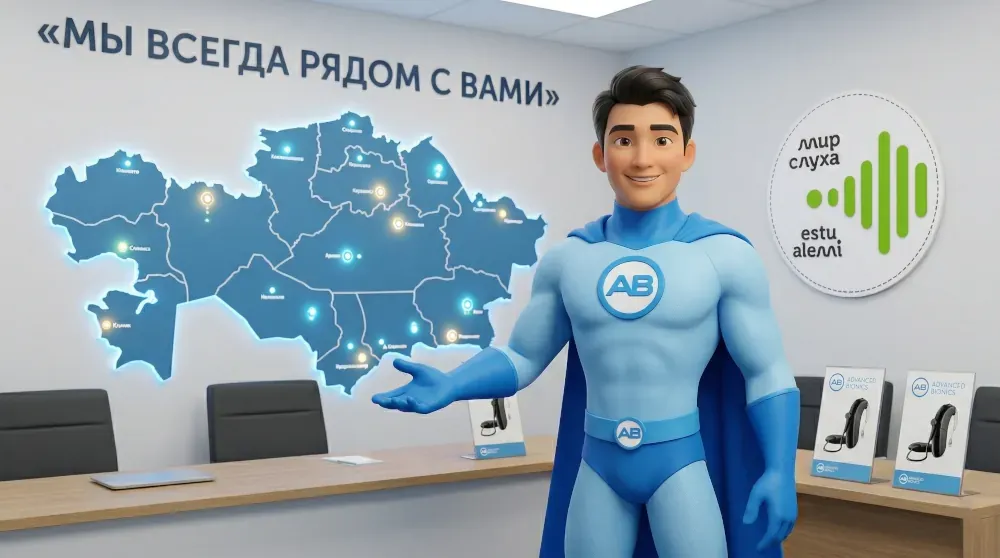
4. Accessible care: 16 branches across Kazakhstan
Kazakhstan is a big country. One of the most common problems families face after implantation is having to travel hundreds of kilometers just to get the processor fitted.
We operate through 16 branches across Kazakhstan. This means a specialist is nearby for most families.
For families with children, this isn't just a convenience. It's the ability to keep to the recommended fitting schedule and ensure optimal hearing development.
5. Remote fittings: when coming in person isn't possible
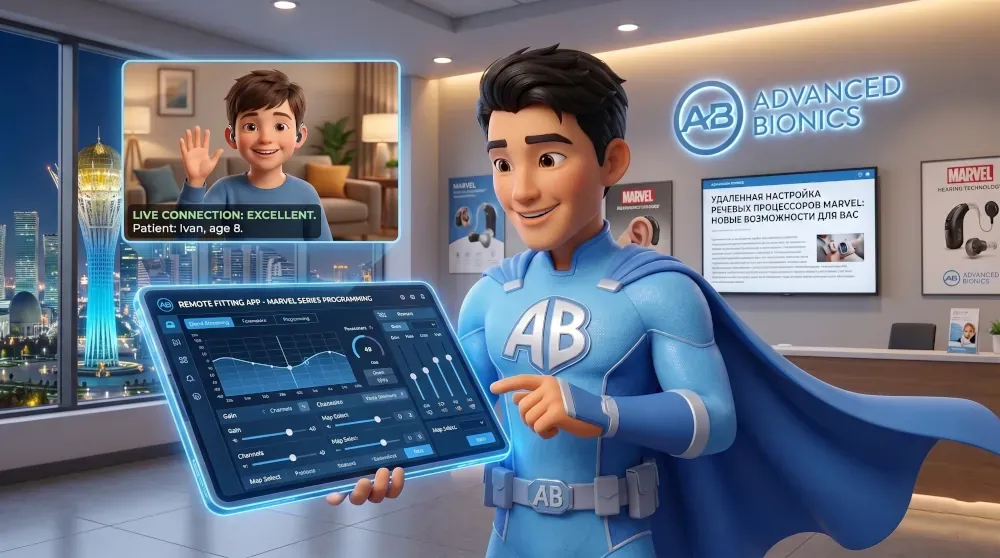
Advanced Bionics supports remote fitting technology (AB Remote Support): a specialist connects to the processor over a secure internet connection and conducts a full fitting session online.
For families from remote regions, frequent travelers, and parents with busy work schedules, this feature changes everything.
6. Fitting flexibility: a system that grows with the patient
Advanced Bionics systems offer a wide range of individual settings. This isn't "one size fits all" — it's personal calibration that adapts as hearing develops.
7. Compatibility with 3 Tesla MRI: freedom for years to come
This question is rarely asked when choosing an implant — and it shouldn't be overlooked. Life is unpredictable, and an MRI scan may become necessary in the future.

The HiRes Ultra 3D implant from Advanced Bionics is compatible with MRI up to 3 Tesla without surgical magnet removal, preparation, or head bandaging (subject to the manufacturer's conditions).
Ten key criteria for choosing a cochlear implant
A side-by-side comparison in one convenient table: Reliability • Technology • Warranty • Cost of service • Support and other important advantages of Advanced Bionics.
Open PDFChecklist: what to clarify before choosing

- Who is the manufacturer? How long has the company been working in cochlear implantation?
- Is the manufacturer a public company (are its shares traded on an exchange)?
- On average, how many fittings are needed per year?
- In most cases, can fitting be done without a speech-language pathologist present?
- Can fitting be done for free under OSMS?
- What are the terms for replacing broken parts? Is free replacement available for mechanical damage?
- Is there service support in Kazakhstan and in your city and region?
- Where and how often does the processor need to be fitted?
- Is remote fitting available?
- What are the MRI conditions for the specific implant model?
- Who supports the patient after surgery, and how is rehabilitation organized?
- Is a bimodal pairing with a hearing aid possible?
- Does a single distributor handle patient selection, implant supply, rehabilitation and servicing?
Frequently asked questions
Can you have an MRI with a cochlear implant?
It depends on the implant model. The HiRes Ultra 3D from Advanced Bionics is compatible with MRI up to 3 Tesla without magnet removal — subject to the manufacturer's conditions. Always tell your doctor about the implant before any scan.
Do I have to travel to another city for every fitting?
No. Most patients have access to one of 16 branches across Kazakhstan. And where technically possible, remote fitting is available online via AB Remote Support.
Can you play sports with an implant?
Yes. The system is securely attached and has a high level of protection. MRI compatibility also makes medical monitoring easier for patients who are active in sports.
What matters more — the implant, the processor, or rehabilitation?
The whole system matters. The device, the fittings, the specialists' work and rehabilitation all complement each other. You can't consider the implant separately from ongoing support.
Are regular fittings needed after surgery?
Yes, especially in the first months and years. The frequency depends on the patient's age, the stage of adaptation, and the specialist's recommendations. That's exactly why service availability is one of the key selection criteria.
Where to start?
If you've read this far, it means you're already taking this choice seriously. That's very important.
The next step doesn't commit you to anything: just talk to our audiologist. Ask the questions that concern you — about technology, service, and how this works specifically in your case.
The consultation is free and doesn't commit you to anything.